Dental Group Cuts Patient Pay Cycle from 96 to 22 Days

A recession-driven slowdown in patient payments created a serious cash flow strain at Bay Coast Dental Group, pushing aged receivables to record levels ahead of lender review.
Business Challenges
Throughout 2024, Bay Coast Dental Group experienced a steady deterioration in patient-pay collections across its 14 locations. CFO Wendell Bram monitored patient receivables weekly as macroeconomic pressure began affecting how quickly patients settled balances.
While treatment acceptance rates remained stable, the timing of payments shifted significantly. Patients increasingly delayed payments after treatment, leading to a sharp rise in outstanding balances older than 90 days, which reached $2.4M by year-end — the highest level in the organization’s history.
With a lender review scheduled for March 2025, this trend became a critical concern. The lender was closely watching patient-pay AR as a measure of operational discipline and financial stability. Key weaknesses were already clear: average time from treatment acceptance to first payment stood at 18 days, card-on-file adoption was just 9%, and payment-plan utilization was only 14%.
Communication processes also contributed to delays. Reminder messages were generic, vendor-managed, and not optimized for patient behavior, while payment-plan setup required manual intervention through phone calls, reducing conversion rates further.
The result was a structurally slow collection cycle that no longer aligned with patient behavior in a constrained economic environment.
- Patient-pay AR > 90 days reached $2.4M by year-end 2024 — the highest level in the practice’s history.
- Treatment-plan acceptance to first patient payment averaged 18 days; the latency was structurally too long for the current consumer environment.
- Card-on-file adoption sat at 9% of patients; payment-plan adoption at 14%.
- Statement-only patient communication had low engagement; reminder cadence was vendor-driven without practice-specific tuning.
- Lender’s debt-service review was scheduled for March 2025; patient-pay AR growth was the operational metric most likely to trigger covenant scrutiny.
Solution
Wendell structured the transformation around a strict 90-day window leading up to the lender review. The goal was clear: materially improve patient-pay conversion metrics within a single quarter.
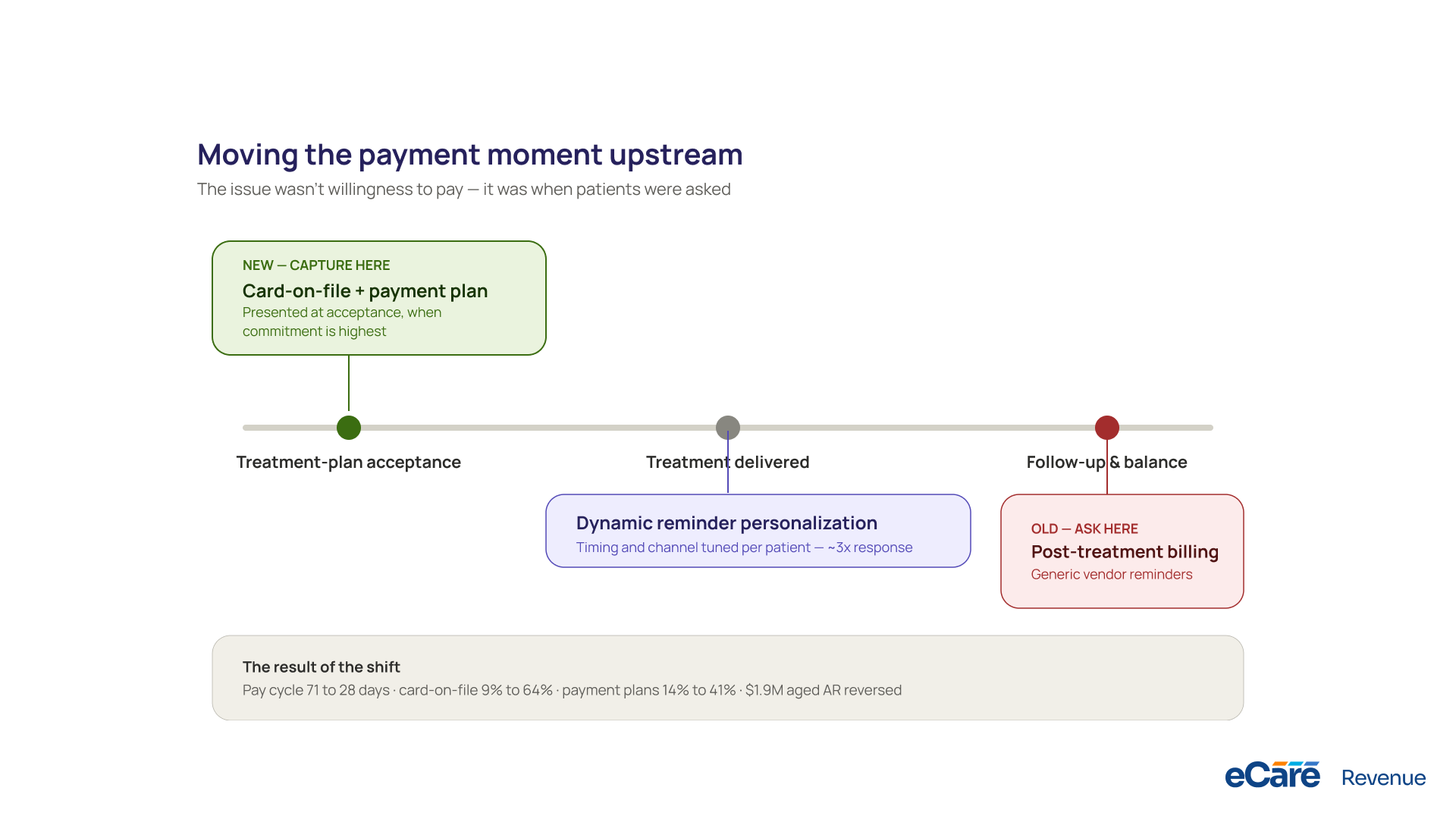
After evaluation, Bay Coast selected eCareRevenue for its ability to shift payment engagement earlier in the patient journey. Instead of relying on post-treatment billing cycles, the platform embedded payment options directly into the treatment-plan acceptance process, where patient commitment is highest.
This included immediate presentation of card-on-file enrollment and structured payment-plan options at the point of acceptance, reducing friction and improving uptake.
A second major capability was dynamic reminder personalization. The platform adjusted communication timing and delivery channels based on individual patient response patterns, replacing the rigid third-party reminder system that had previously driven low engagement.
Together, these changes addressed both upfront payment capture and downstream collections efficiency.
Value Delivered
Within 90 days, meaningful improvements were already visible, and by the time of the lender review, Bay Coast had demonstrated a clear upward trajectory in collections performance. Over the following year, improvements fully stabilized across all locations.
The patient-pay cycle dropped from 71 days to 28 days within 12 months. Outstanding receivables older than 90 days declined by $1.9M, reversing the prior upward trend. Card-on-file adoption increased sharply from 9% to 64%, while payment-plan utilization rose from 14% to 41%.
- The patient-pay AR cycle dropped from 71 days to 28 days within 12 months.
- $1.9M reduction in > 90 days aged AR; the position that had been growing reversed structurally.
- Card-on-file adoption lifted from 9% to 64% across the patient base.
- Payment-plan adoption lifted from 14% to 41%; patients used the structured payment options when surfaced at acceptance time.
- $1.2M accelerated cash collection in the first year of full deployment.
Solution Provided
The deployment was completed in 11 weeks and structured tightly around the lender’s 90-day review timeline.
Weeks 1–3: Treatment-Plan-Acceptance Workflow Configuration
The initial phase focused on embedding payment options into the treatment-plan acceptance workflow across three pilot locations. Patients were presented with card-on-file and payment-plan options at the moment of acceptance, rather than after treatment completion, fundamentally shifting conversion timing.
Weeks 4–6: Pilot Adoption Measurement
During the pilot phase, adoption rates improved rapidly. Card-on-file enrollment rose from 11% to 58%, while payment-plan usage increased from 13% to 36%. These results confirmed that timing, not patient willingness, was the primary barrier in the prior workflow.
Weeks 6–9: Network-Wide Rollout
The system was expanded across all 14 locations. Front-desk teams were trained to integrate payment workflows into daily operations. Adoption performance varied slightly by location, but overall trends remained strongly positive, supported by operational coaching and visibility dashboards.
Weeks 9–11: Reminder-Cadence Personalization Activation
The final phase replaced the vendor-managed reminder system with behavior-based communication logic. Patients with outstanding balances received reminders tailored to their engagement patterns, resulting in approximately 3x higher response rates compared to the previous system.
Business Value
Wendell presented the final results at Bay Coast’s board meeting in early 2026, framing the engagement as a structural correction to patient-pay collections that had been exposed by recessionary pressure.
What the engagement preserved at the practice level
The most important outcome was the stabilization of cash flow and avoidance of lender escalation. With improved collections performance, Bay Coast maintained financial stability through the lender review cycle, avoiding covenant pressure and restoring predictable AR behavior.
The practice’s patient-pay position is now structurally stronger than its pre-recession baseline, with improved predictability across all locations.
The financial picture
The engagement delivered both immediate and recurring financial benefits. Accelerated collections contributed approximately $1.2M in near-term cash flow improvement. Reduced aged AR and improved capital efficiency preserved approximately $280K annually in working capital value. Retiring the third-party reminder vendor added a further $140K in annual savings.
Total recurring annual financial impact is estimated at approximately $1.6M, achieved against a $240K implementation cost.
What changed about Bay Coast’s growth thesis
Improved cash flow fundamentally changed Bay Coast’s expansion trajectory. Planned openings for a 15th and 16th location, initially at risk due to liquidity constraints, remained on track. The accelerated patient-pay cycle provided the financial capacity to support continued growth without additional external financing pressure.
What changed about patient-pay as a discipline
Patient-pay collections shifted from a reactive billing function to an embedded operational workflow. Front-desk teams now treat payment option presentation as part of standard treatment-plan acceptance, reducing reliance on post-service collections activity.
The process is now consistent, structured, and integrated directly into patient engagement workflows across all locations.
The CFO’s framing
“The issue wasn’t willingness to pay — it was when and how we asked patients to engage. By moving payment options into the treatment acceptance moment, we changed the entire cycle. The cash acceleration is the outcome, but the real change is that collections are no longer a downstream problem.”