Multi-Specialty Group Recovers $3.4M in Revenue Leakage

A new CFO at Bayou Multispecialty Health inherited a long-standing “revenue leakage estimate” of $3–8M annually. His first priority was turning that estimate into a measurable number and then reducing it.
Business Challenges
Jonathan Belvedere joined Bayou Multispecialty Health as CFO in January 2025. During his initial transition discussions, he learned that the organization had carried an unverified revenue leakage estimate of $3–8M annually for more than three years.
The range existed because the system lacked the operational visibility to precisely quantify where revenue was being lost. Jonathan viewed this ambiguity as a structural financial risk. His commitment to the board was clear: within six months, the organization would establish a validated leakage figure and begin recovery efforts.
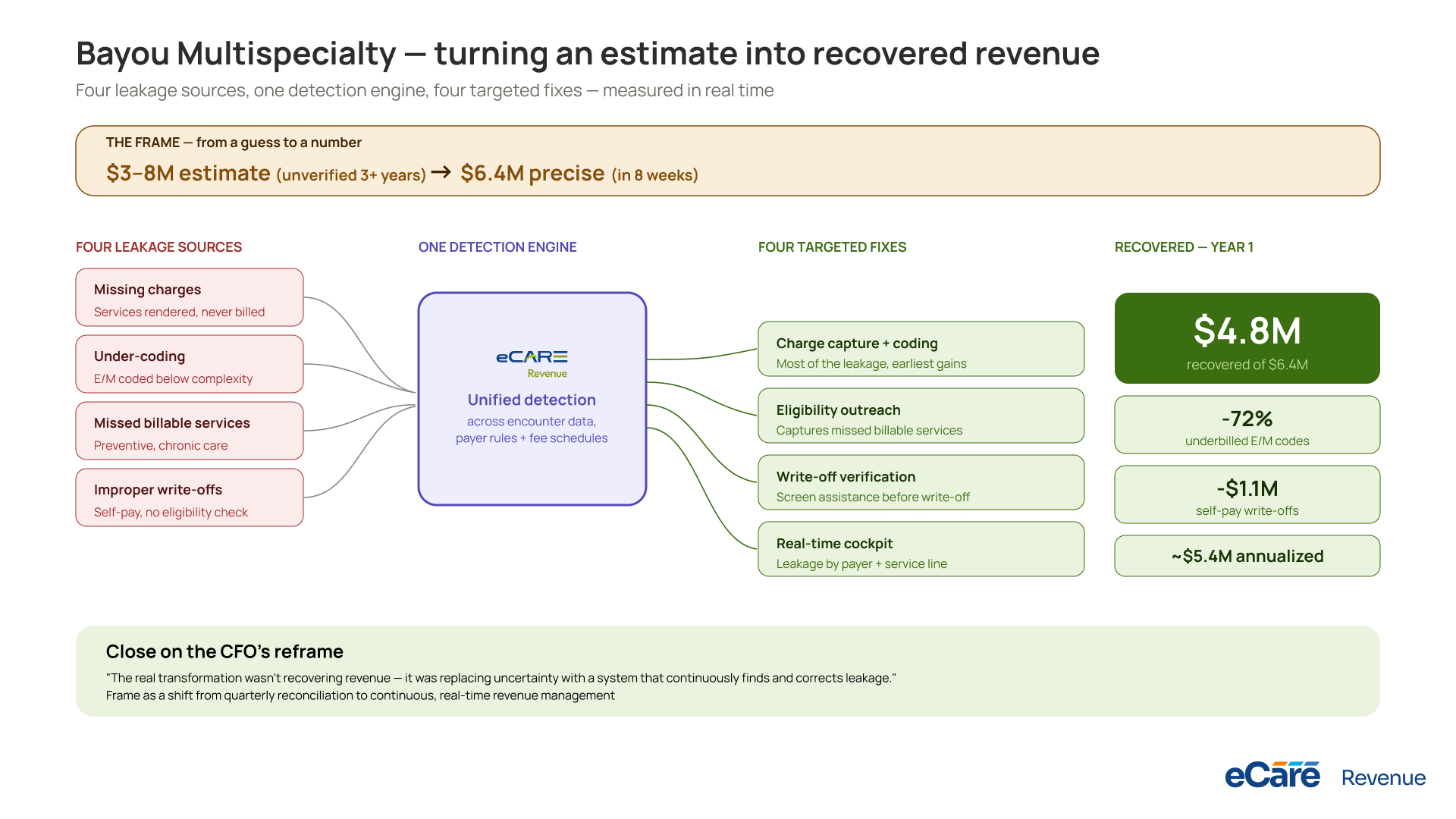
A deeper review showed that leakage was not a single issue but multiple overlapping breakdowns across revenue operations. These included missing charges, under-coded encounters, unbilled clinical services, and improper self-pay write-offs. Each category followed a different failure pattern and required a distinct remediation approach.
Payer and service-line visibility was also delayed, with performance trends only surfacing at quarterly close. This meant leadership was consistently reacting to outdated financial signals rather than managing revenue in real time.
- The system carried a $3–8M annual revenue leakage estimate without validation for over 3 years.
- Leakage originated across four categories: missing charges, under-coding, missed billable services, and write-offs.
- Each leakage type required different detection and remediation methods.
- Revenue visibility by payer and service line was delayed until quarterly reporting cycles.
- Leadership lacked real-time insight into operational revenue performance.
Solution
Jonathan’s procurement approach was driven by a strict six-month board commitment. Any solution had to deliver a measurable leakage baseline within 60 days of deployment and enable remediation workflows within the following 90 days.
eCareRevenue’s revenue intelligence platform was selected after evaluation against multiple alternatives. Its key advantage was unified leakage detection across encounter data, payer rules, and fee schedules, allowing all four leakage categories to be identified within a single system.
Equally important was the executive-level visibility layer. The platform introduced a real-time revenue cockpit that surfaced leakage trends by payer and service line, enabling CFO-led intervention in near real time rather than after month-end close.
Value Delivered
Within eight weeks, the platform established a validated leakage figure of $6.4M annually. Structured remediation began immediately afterward, and by the end of the first year, $4.8M had been recovered.
- $6.4M annual revenue leakage precisely quantified within 8 weeks.
- $4.8M recovered in Year 1 through structured remediation workflows.
- $1.6M remaining leakage actively addressed through ongoing optimization.
- Real-time encounter-level leakage detection replaced retrospective reconciliation.
- $1.1M reduction in self-pay write-offs through eligibility verification workflows.
- Payer and service-line visibility shifted from quarterly to continuous monitoring.
Solution Provided
The 13-week deployment was structured to first establish measurement accuracy, followed by staged activation of remediation workflows.
Weeks 1–4: Data Integration and Baseline Measurement
Core systems were integrated, including encounter data, payer rules, and fee schedules. Initial leakage modeling began during this phase, with validated reporting established by week 8.
Weeks 5–8: Missing Charge and Under-Coding Remediation Workflows
Missing charge detection and under-coding correction workflows were activated. These two areas accounted for the majority of identified leakage and delivered early recovery gains.
Weeks 8–10: Billable-Service Eligibility Workflow
Eligibility workflows surfaced missed opportunities such as preventive visits and chronic care management, enabling structured outreach and claim capture.
Weeks 10–12: Self-Pay Write-Off Eligibility Verification
Self-pay accounts were screened for assistance programs before write-off, significantly reducing preventable revenue loss.
Weeks 12–13: Executive Cockpit Activation
A real-time dashboard was launched for leadership, enabling continuous tracking of leakage, recovery, and service-line performance.
Business Value
Jonathan presented the 12-month engagement results to Bayou’s board in early 2026. The framing shifted from “leakage estimation” to confirmed, system-driven revenue recovery.
What changed about Bayou’s revenue management posture
Revenue operations at Bayou moved from periodic reconciliation cycles to a continuous monitoring model. Leakage, which was previously handled through rough estimation and post-close analysis, is now managed through real-time detection and structured remediation workflows. This shift improved financial visibility and strengthened confidence in forward-looking planning decisions.
The financial picture
The $4.8M recovered in Year 1 represents the immediate impact of the engagement. As structural workflow improvements continue to mature, Year 2 projections indicate approximately $5.8M in sustained recovery. Overall, the organization is tracking toward an annualized financial impact of approximately $5.4M against a $640K implementation cost.
What changed about Jonathan’s CFO posture
The engagement significantly strengthened the board’s confidence in the CFO’s operational control. Decision-making authority expanded as revenue visibility improved, reducing the need for board-level escalation on routine financial issues. Several previously deferred expansion initiatives were subsequently approved based on improved predictability in revenue performance.
What the CFO says publicly
“The $3–8M range was never a workable position once we had the ability to measure accurately. The real transformation wasn’t just recovering revenue, it was replacing uncertainty with a system that continuously identifies and corrects leakage. That changed how we run finance operations.”